Lithium Battery Manufacturers in Pakistan (2026 Guide)
A buyer's guide to lithium battery manufacturers in Pakistan for 2026 - LFP vs lead-acid, key certifications, and how to vet a supplier before ordering.
Lithium Battery Manufacturers in Pakistan: A Buyer's Guide for 2026
If you're sourcing lithium batteries from Pakistan right now, you're early - and that's exactly why this guide exists. Unlike garments or rice, where Pakistan has decades of export infrastructure behind it, lithium battery manufacturing here is only just being built. That changes how you should shop for it. You're not choosing between fifty established factories; you're choosing between a handful of real manufacturers, a wave of import-and-rebrand sellers, and a government policy that's about to reshape pricing and supply within the next year. Getting this right means understanding which is which before you commit to an order.
Why Pakistan's Lithium Battery Market Matters Right Now
Pakistan's lithium-ion battery market was worth $394.6 million last year and is projected to reach $826.5 million by 2031. Automotive applications alone accounted for 40.5% of the battery market in 2025 and are expected to grow at a 12.5% CAGR through 2031, driven largely by electric two-wheelers, solar storage, and backup power for telecom towers and sensitive facilities like banks.
Almost all of that demand is currently met through imports - roughly three gigawatt-hours of lithium-ion batteries were imported last year, a figure expected to more than double to eight gigawatt-hours by 2030. That's the gap the government is trying to close.
The National Lithium-Ion Battery Manufacturing Policy 2026–31 is the reason this category is worth watching as a buyer. A dedicated working group was constituted in December 2025, and the policy - built around phased localization, tariff reforms, and performance-based incentives - has already been forwarded to the Ministry of Industries and Production for review by the National Tariff Board. The committee has approved lithium iron phosphate (LFP) chemistry as the first technology for local localization, citing its stability and popularity for energy storage and electric mobility. Officials have also pointed to Pakistan's phosphate, iron, and manganese reserves as a potential domestic input base, and named the Pakistan Standards and Quality Control Authority (PSQCA) as the body responsible for certifying that locally made batteries meet international safety and performance benchmarks.
If the policy clears cabinet approval and is reflected in the 2026–27 budget as expected, import tariffs on battery components should drop — which matters directly for your landed cost if you're sourcing finished packs versus components today.
What Buyers Should Understand Before Sourcing
Before you contact a single supplier, get clear on three things: the chemistry you need, the certifications that actually apply to your shipment, and whether the company you're talking to manufactures, assembles, or simply imports and rebrands.
Chemistry first. Not all "lithium batteries" are the same. LiFePO4 (LFP) is the chemistry Pakistan's own policy has prioritized, and it's also the safer, longer-cycle-life option for solar storage, UPS, and stationary backup — which is most of the demand coming from Pakistani buyers and exporters right now. NMC (nickel-manganese-cobalt) chemistries pack more energy into less weight and show up more in EVs and portable electronics, but they run hotter and need tighter thermal management.
Then match the certification to the use case. A battery destined for a UPS installation in a bank has different compliance requirements than one going into an e-bike, and both are different again if you're re-exporting the finished product internationally rather than selling locally.
Where Lithium Batteries Are Actually Used
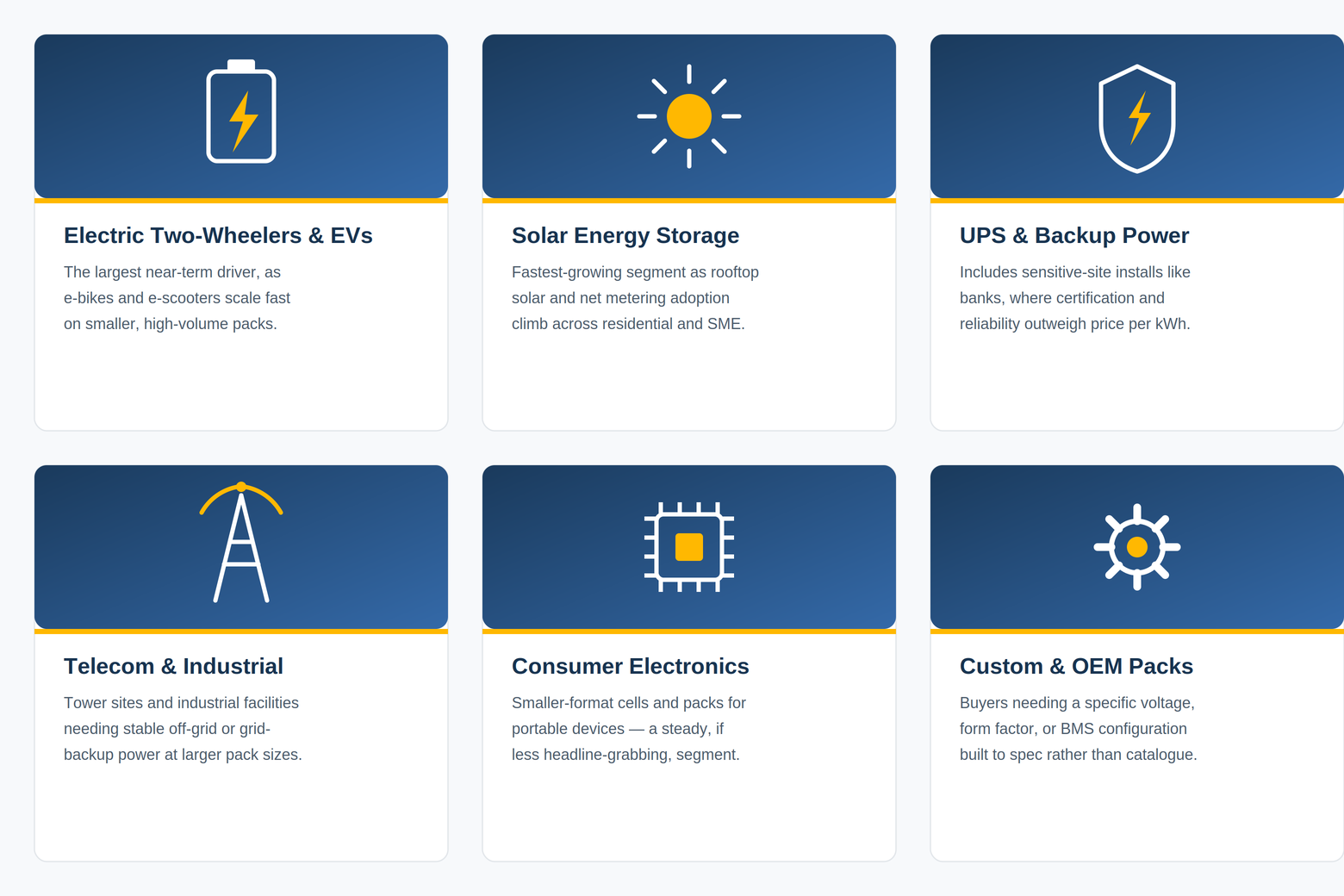
Electric Two-Wheelers & EVs — the single largest driver of near-term demand, as petrol prices push riders toward e-bikes and e-scooters. Pack sizes here are smaller but order volumes can be high once a model is qualified.
Solar Energy Storage — the fastest-growing category as net metering and rooftop solar adoption both climb. Buyers in this segment care most about cycle life and depth of discharge, since these packs cycle daily for years.
UPS & Backup Power — includes sensitive-site installations like banks and data rooms, where reliability and certification matter more than price per kWh.
Telecom & Industrial Backup — tower sites and industrial facilities that need stable off-grid or grid-backup power, often at larger pack sizes than residential solar.
Consumer Electronics — smaller-format cells and packs for portable devices, a smaller but steady segment.
Custom & OEM Packs — buyers who need a specific voltage, form factor, or BMS (battery management system) configuration built to spec rather than off a catalogue.
Certifications & Standards That Matter to Buyers
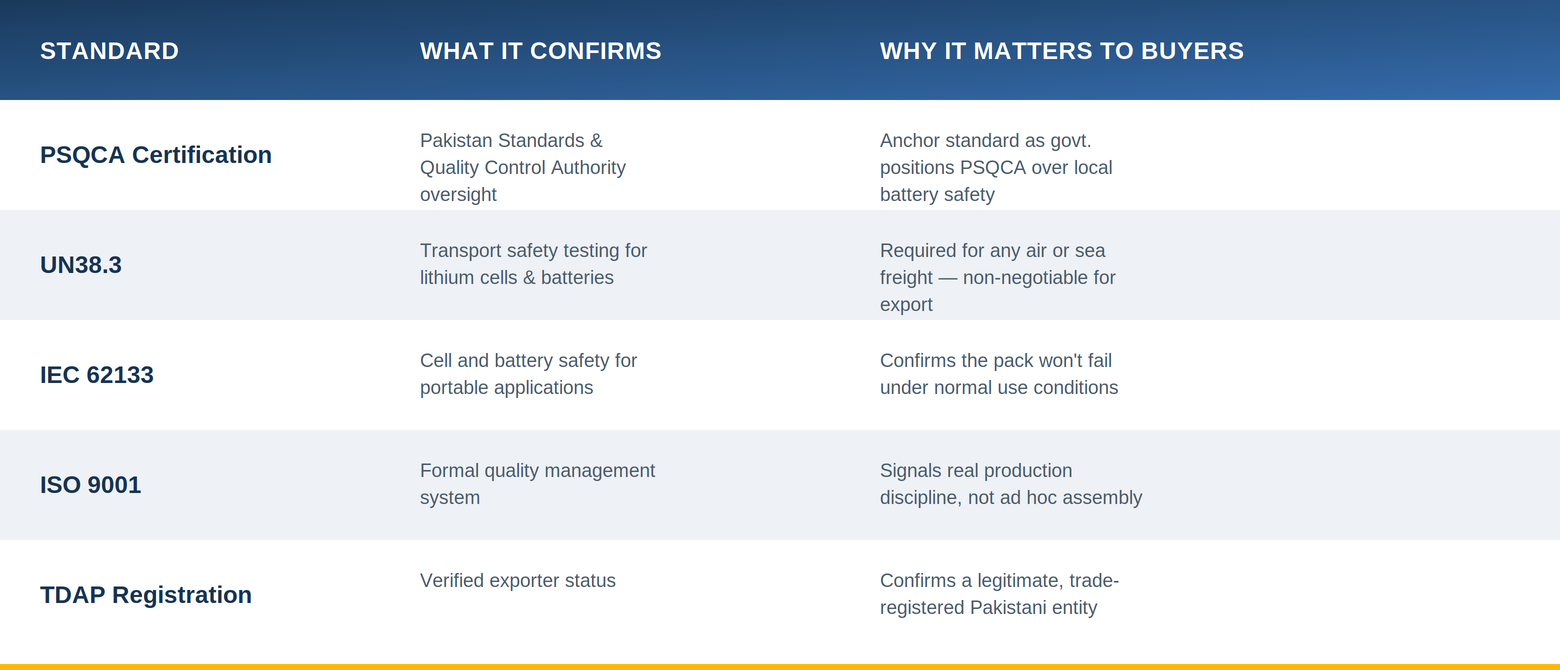
None of these certifications are optional box-ticking - each one answers a specific question a serious buyer should be asking before placing an order.
PSQCA certification is becoming the anchor standard as the government positions the Pakistan Standards and Quality Control Authority to oversee local battery safety and performance benchmarks under the new policy. UN38.3 is non-negotiable if your batteries will ever travel by air or sea - it's the transport safety test every lithium shipment needs to clear customs and freight carriers. IEC 62133 covers cell and battery safety for portable applications, while ISO 9001 signals that a manufacturer has a real quality management system behind its production line rather than ad hoc assembly. If you're re-exporting, TDAP registration confirms the seller is a legitimate, trade-registered Pakistani entity - the same baseline check that matters across every export category, not just batteries.
Lithium-Ion vs. Lead-Acid: Why Buyers Are Switching
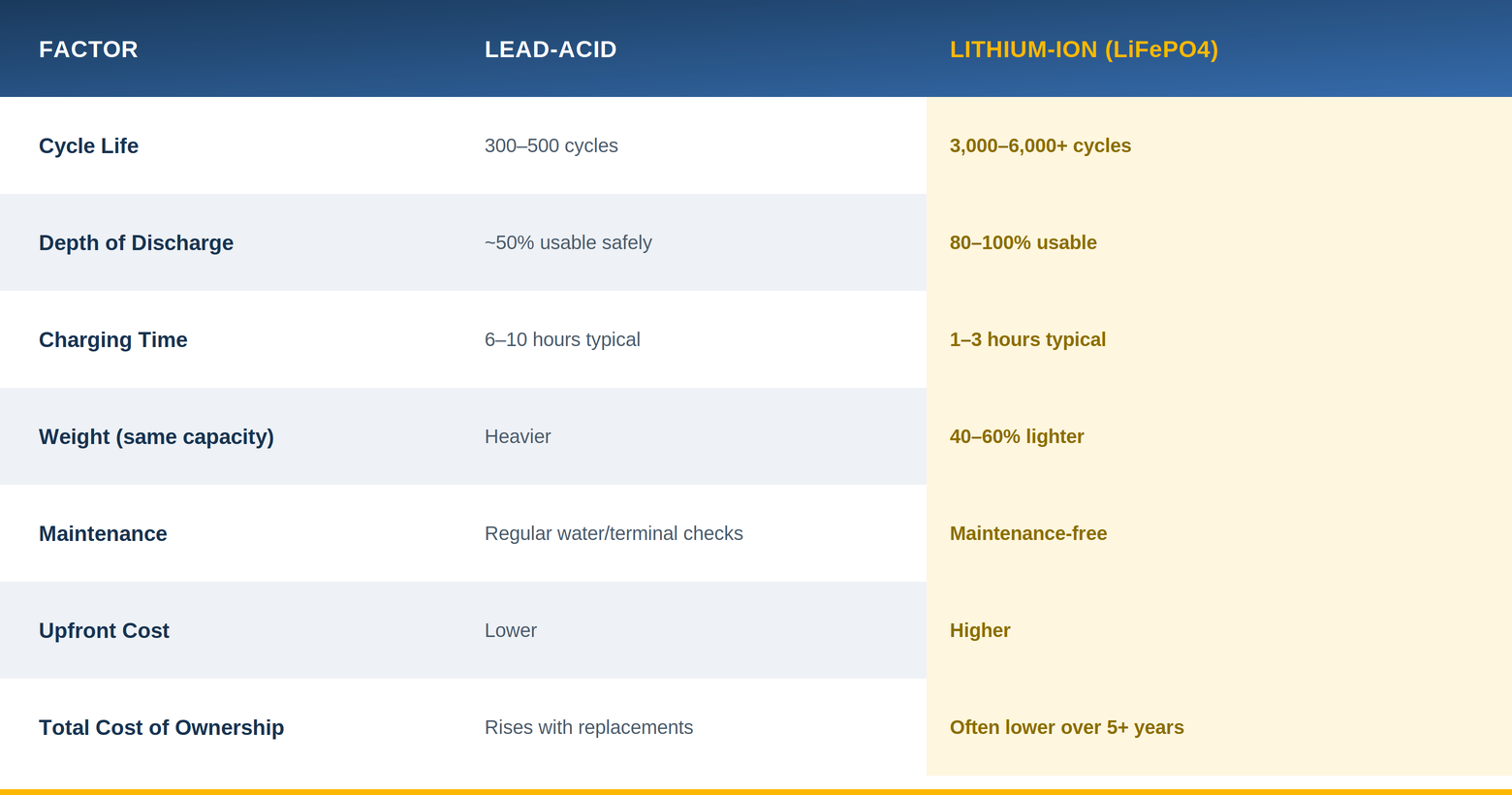
This is the comparison every Pakistani buyer coming from a solar, UPS, or automotive-battery background is implicitly making, even if they haven't put numbers to it yet. Lead-acid is cheaper upfront and it's what most of the market has installed today. Lithium-ion, particularly LiFePO4, costs more per unit but delivers roughly three to four times the cycle life, charges faster, and can be discharged much deeper without shortening its lifespan - which is exactly why solar installers and telecom operators are increasingly specifying it despite the higher sticker price. Over a multi-year deployment, the total cost of ownership frequently favors lithium once you account for replacement frequency and maintenance labor.
Manufacturers and Suppliers to Know
This list mixes three different kinds of companies, and it's worth knowing which is which before you reach out.
Public, verifiable manufacturing activity:
EV Technologies is building what's reported to be Pakistan's first dedicated lithium-ion battery production plant, in the Korangi Industrial Area of Karachi. Coverage from Dawn and Profit by Pakistan Today confirms an initial capacity of 4 megawatts - enough to supply roughly 2,000 e-bike and e-scooter batteries per month - with production expected to begin within months of the reports.
Atom Power is credited by industry research (Mordor Intelligence) with producing Pakistan's first locally assembled lithium-ion pack in December 2024, and is targeting 100 MWh of assembly capacity by 2026, with a planned second phase to add prismatic cell manufacturing using domestically processed graphite.
HUBCO has announced a vertical-integration strategy spanning mining through vehicle-battery assembly, according to the same industry research.
Established battery makers expanding into lithium:
Exide Pakistan Limited and Atlas Battery Limited are long-established, PSX-listed names in Pakistan's conventional (largely lead-acid) battery industry that are reported to be extending into lithium-ion product lines. If lithium is central to your order, confirm directly which specific lithium products are currently in production versus planned.
Zhejiang Narada Power Source operates in the Pakistani market with a LiFePO4 range aimed at telecom backup, UPS, and renewable energy installations, per industry market analysis.
Specialized and newer entrants (company-stated positioning — verify directly):
Topak Power describes itself as Pakistan's first lithium-ion battery manufacturer, operating through a partnership with Shenzhen Topak New Energy Technology Co., Ltd., with a plant serving residential, commercial, industrial, and telecom sectors.
Badar Energy, based in Karachi, positions itself as a lithium battery and solar energy storage provider focused on the residential and commercial solar segment.
A practical note: several of these overlapping "first in Pakistan" claims exist because manufacturing, assembly, and rebranding sit on a spectrum, and companies describe their own position on it differently. Ask any shortlisted supplier directly whether they manufacture cells, assemble imported cells into packs, or import finished, branded units - the answer changes your due diligence checklist.
How to Vet a Lithium Battery Supplier in Pakistan
Start by asking whether they manufacture, assemble, or import - get this in writing, not just verbally. Then request test reports for UN38.3 (transport) and whichever safety standard applies to your end use, rather than accepting a general "certified" claim. Ask for the specific cell chemistry and brand of cells used inside the pack, since a supplier's own brand name often sits on top of third-party cells. Request cycle-life data under realistic conditions, not just the marketing headline number. And if you're importing the finished product internationally, confirm TDAP registration and get clarity on HS code classification early - battery HS codes affect duty rates significantly, and getting this wrong at the quoting stage causes problems at customs later.
Frequently Asked Questions
Is Pakistan currently manufacturing lithium batteries, or mostly importing them?
Today, the large majority of lithium-ion battery demand in Pakistan is met through imports. Local manufacturing and assembly are emerging — led by projects like EV Technologies' Korangi plant and Atom Power's pack assembly — but full-scale domestic cell production is still being built out, with the National Lithium-Ion Battery Manufacturing Policy 2026–31 designed to accelerate that shift.
Which battery chemistry should I ask for?
For solar storage, UPS, and backup power, ask for LiFePO4 (LFP) - it's the chemistry Pakistan's own policy has prioritized and it offers longer cycle life and better safety margins for stationary use. For lightweight EV or portable applications, NMC chemistries are more common, but confirm thermal management specifications.
How many lithium battery companies are actually manufacturing in Pakistan versus importing?
It's a small, fast-changing group. A handful of companies have announced or begun local assembly or manufacturing in the last two years; most of the wider market is still supplied through imported, finished battery units sold under local or international brand names.
What should I check before placing a first order?
Confirm manufacturing status (manufacture vs. assemble vs. import), request UN38.3 transport certification, verify the actual cell brand and chemistry inside the pack, and ask for real-world cycle-life data rather than headline specifications.
You can view the products listed orsign up on Baramdat for free