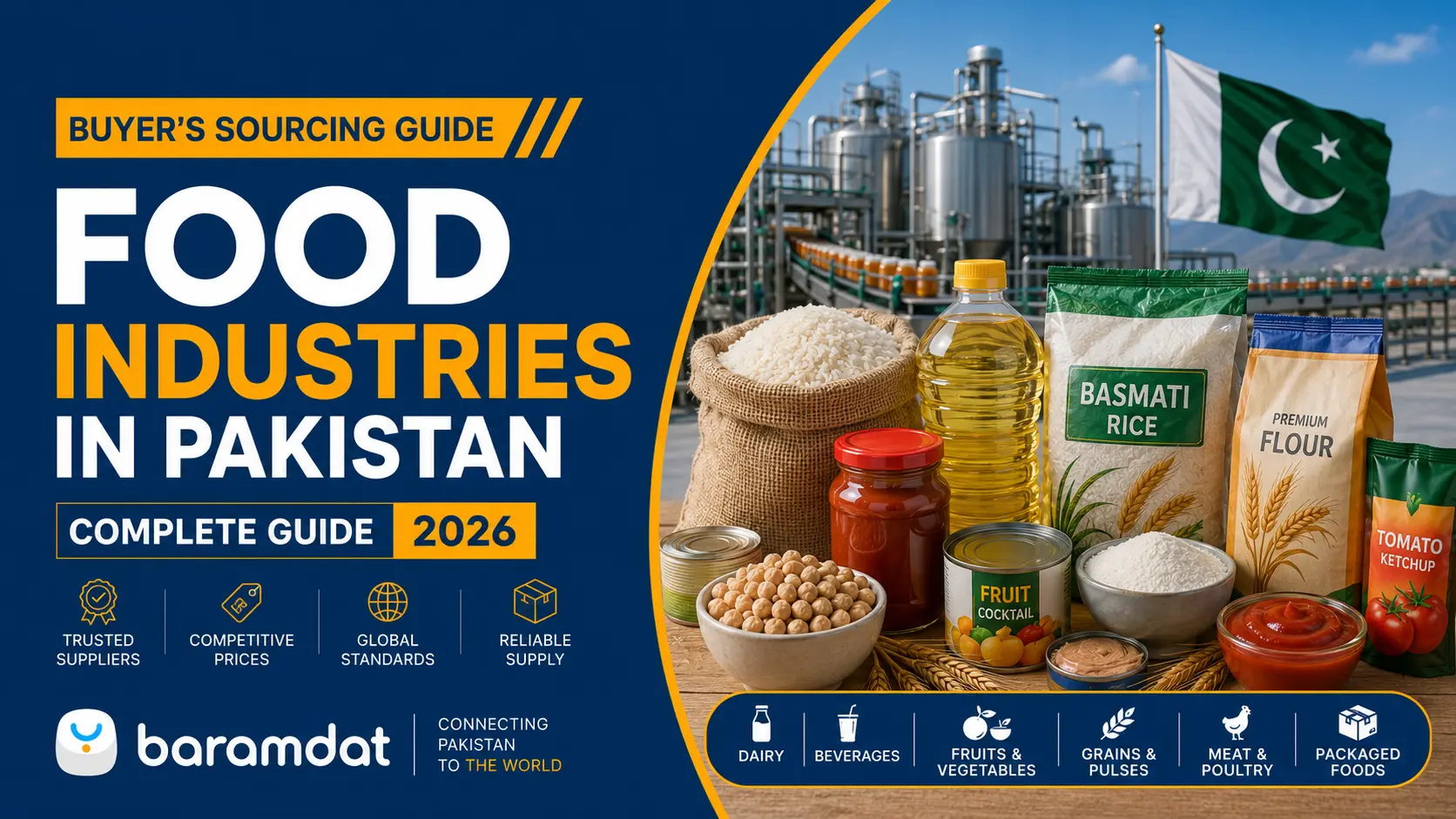
Food Industries in Pakistan: A Buyer's Sourcing Guide 2026
Sourcing food products from Pakistan? Here's a buyer's breakdown of the country's food export categories, certifications to check, and how to vet a supplier.
If you're importing food products and Pakistan has come up as a sourcing option, you've probably noticed the research is scattered. You'll find government PDFs listing dozens of "processing industries," directory sites with hundreds of unverified company names, and association pages that read like annual reports. None of it tells you what you actually need: which categories Pakistan is strong in, what certifications to insist on, and how to avoid a bad first order. This guide walks you through those considerations and, where relevant, points you to food exporters and manufacturers in Pakistan that can help you start your supplier search.
Why Buyers Are Looking at Pakistan's Food Sector
Pakistan is the world's fifth-most populous country and one of the largest agricultural producers in South Asia, giving its food industry two advantages buyers consistently look for: access to domestically sourced raw materials and competitive export pricing. From staple commodities like rice to value-added products such as processed dates, spices, and Himalayan salt, the country has built a well-established food export sector serving buyers across the Middle East, Europe, North America, and Asia.
A few reasons this sector keeps showing up in sourcing conversations:
Strong domestic supply. Many of Pakistan's largest food export categories—including rice, dates, spices, Himalayan salt, and livestock feed—are sourced and processed locally. This helps reduce supply chain complexity and often keeps production costs competitive.
Established export infrastructure. Karachi Port and Port Qasim handle the majority of Pakistan's food exports, with experienced freight forwarders, cold-chain providers, and container services supporting international shipments.
A range of supplier sizes. Buyers can source from large export-oriented manufacturers capable of full-container orders as well as smaller processors and private-label suppliers willing to accommodate lower MOQs, depending on the product category.
Improving compliance with international standards. Many established exporters maintain certifications such as HACCP, ISO 22000, Halal, and, where required, Kosher or EU compliance documentation. Certification levels still vary by supplier, so buyers should always verify documentation before placing an order.
Competitive sourcing opportunities. Compared with many established sourcing markets, Pakistan often offers an attractive balance of pricing, production capacity, and customization, particularly for buyers sourcing agricultural and food products.
None of this means every supplier is export-ready. It means the industry has the capacity — your job is picking the right supplier within it.
The Food Export Categories Worth Knowing
Pakistan's food export strength isn't evenly spread. A few categories dominate; others are more fragmented and need more diligence.
Rice
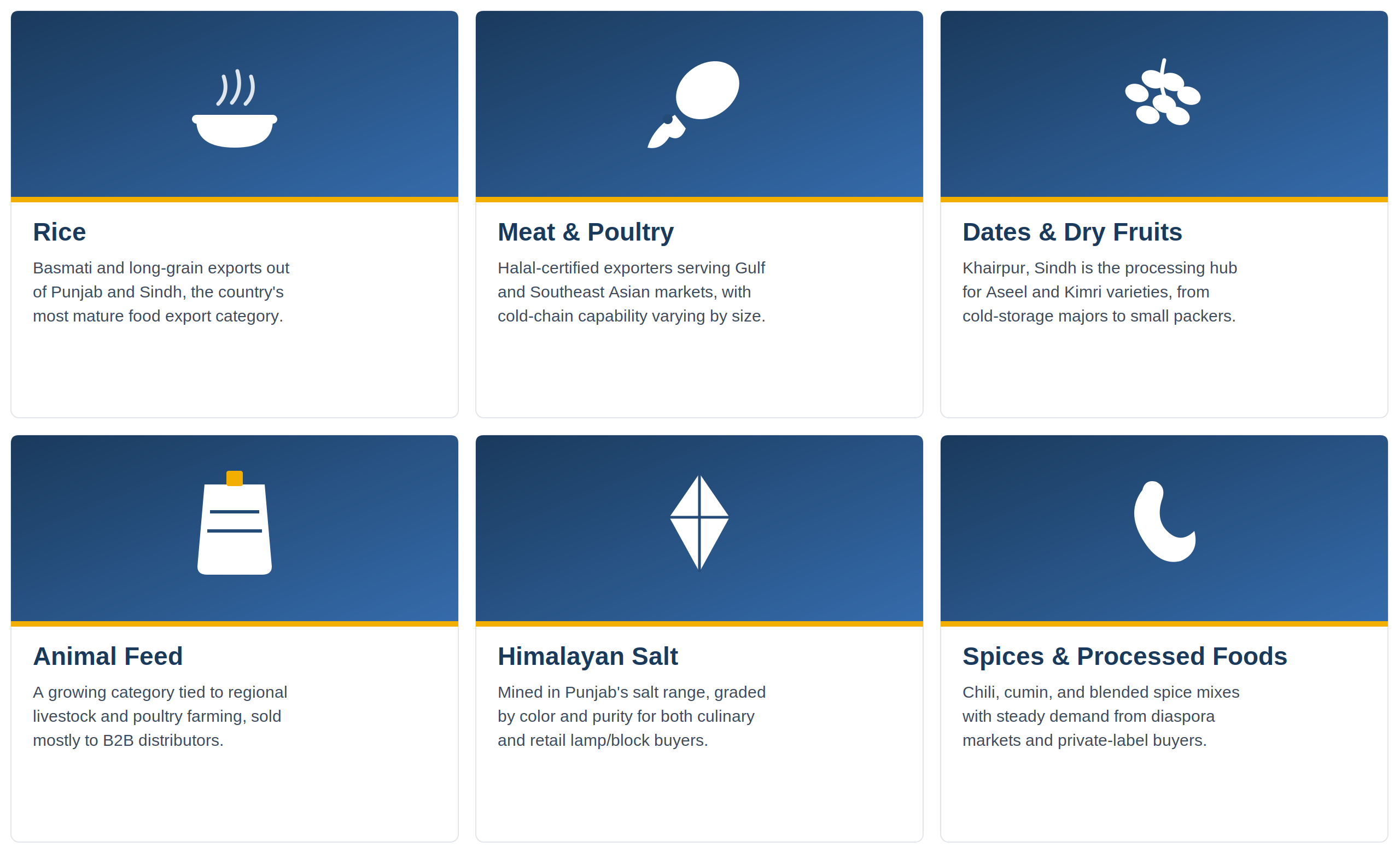
Pakistan is one of the world's largest rice exporters, known specifically for Basmati and long-grain non-basmati varieties. This is the most mature export category — expect established mills, standard grading (broken %, moisture content), and competitive FOB pricing out of Karachi.
Meat & Poultry
Halal-certified meat is a genuine strength, with several exporters holding certifications recognized in the Gulf and Southeast Asia. Cold-chain capability varies a lot by supplier size, so this is a category where you verify infrastructure before you verify price.
Dates & Dry Fruits
Khairpur, Sindh is the country's date-processing hub — Aseel and Kimri varieties are the specialty exports. Suppliers here range from large cold-storage operations (5,000+ MT capacity) to smaller private-label packers, so minimum order sizes vary widely.
Animal Feed
A steadily growing category as regional livestock and poultry farming scales up. Buyers here are usually B2B feed distributors or integrators rather than retail brands, and specs (protein %, moisture, additive-free formulations) matter more than branding.
Himalayan Salt
Technically mined, not farmed, but it sits in the same buyer journey as food exports since most orders go to food-grade or retail (lamps, cooking blocks, culinary salt) buyers. Punjab's salt mines supply the bulk of this category, and grading by color/purity is the main differentiator between suppliers.
Spices & Processed Foods
Smaller in export volume than the categories above, but growing — chili, cumin, and blended spice mixes see steady demand from South Asian diaspora markets and food manufacturers looking for private-label spice blends.
Certifications That Actually Matter
Anyone can claim "export quality" in a product listing. What separates a serious exporter from a listing is documentation you can verify:
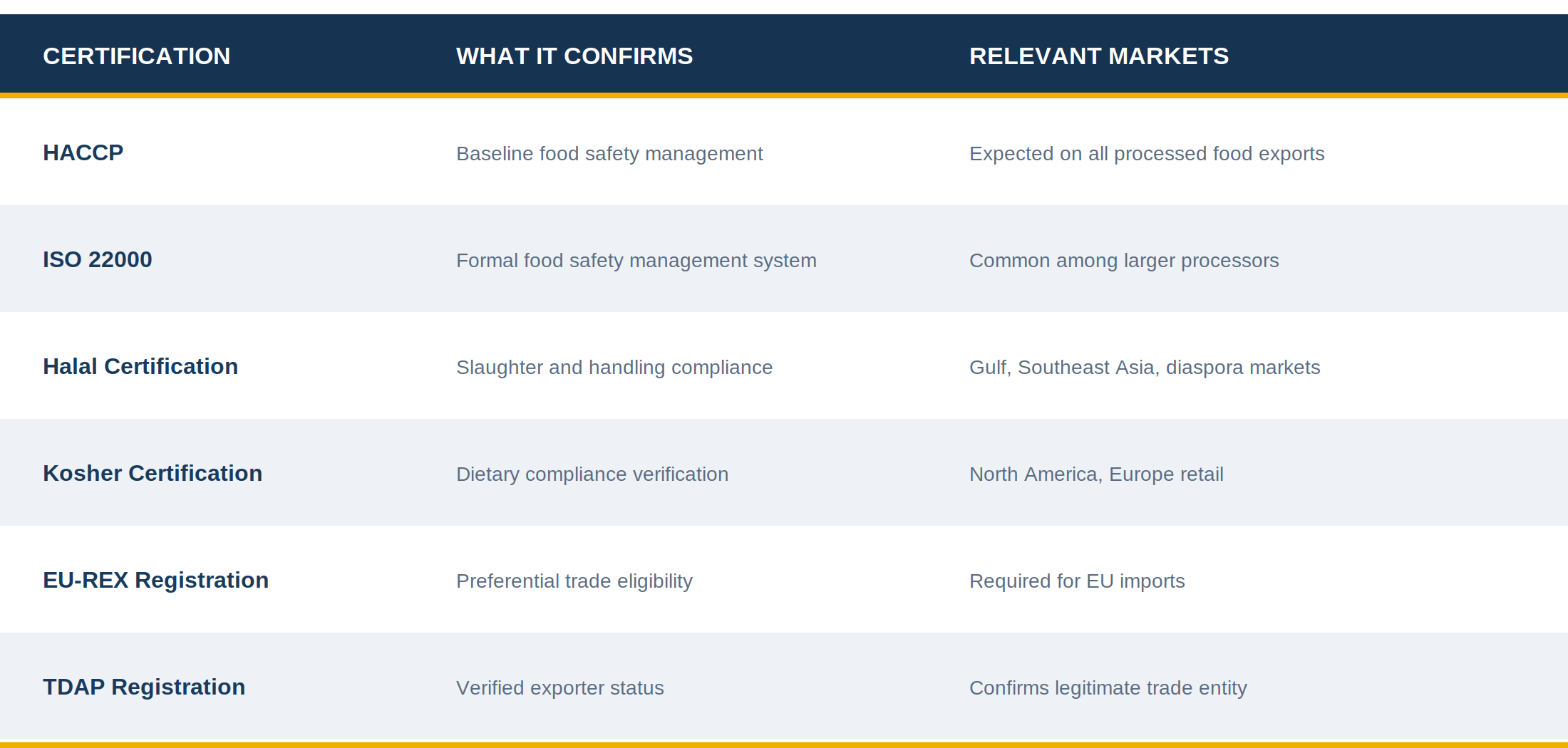
HACCP — baseline food safety management, expected on any processed food export
ISO 22000 — food safety management system, common among larger processors
Halal certification — non-negotiable for Gulf, Southeast Asian, and diaspora markets
Kosher certification — relevant if you're selling into North American or European retail
EU-REX registration — required if you're importing into the EU under preferential trade terms
TDAP registration — confirms the exporter is registered with Pakistan's Trade Development Authority
A supplier that can produce these documents on request is a different conversation than one that just lists them on a webpage. Ask for the certificate number and the issuing body — legitimate exporters won't hesitate.
Where the Suppliers Are Based
Sourcing regions matter for lead time and consolidation:
Karachi — the main port city; home to meat, spice, and general FMCG exporters, and the default consolidation point for mixed-category shipments
Khairpur, Sindh — the dates hub, with cold storage infrastructure built specifically for that category
Punjab (Lahore, Multan, Faisalabad) — rice milling, textiles crossover, and Himalayan salt mining
Islamabad/Rawalpindi — smaller food processors and FMCG manufacturers, less export-focused, more domestic distribution
If you're consolidating multiple product categories into one shipment, a Karachi-based supplier with multi-commodity handling will usually save you a coordination headache versus sourcing from three different regions.
How to Vet a Food Supplier Before You Order
A few checks that catch most problems before they become expensive ones:
Ask for the certification documents directly — not a claim on the website, the actual PDF with a certificate number.
Confirm minimum order quantity in writing before you get attached to a price — MOQs on food products swing widely by category.
Ask about cold-chain handling if the product needs it, and get specifics (refrigerated storage capacity, transport method to port), not a yes/no.
Check for third-party trade coverage — TDAP or REAP membership, chamber of commerce listings, or independent directory verification, separate from what the company says about itself.
Request samples with commercial invoices — a supplier that resists sending trackable samples is a warning sign, not a formality.
Common Mistakes First-Time Buyers Make
Chasing the lowest quoted price without confirming it includes the certifications you need — recertifying or rejecting a shipment at customs costs far more than the price difference.
Assuming one supplier covers every category — a rice exporter and a meat exporter are different businesses with different compliance requirements; don't expect one contact to handle both well.
Skipping the MOQ conversation for dates, spices, or salt — these categories have some of the widest MOQ ranges in Pakistani food exports, from a few hundred kilos to full containers.
Not asking who handles the cold chain — for meat and dates in particular, the exporter and the logistics partner are sometimes different companies, and that handoff is where quality gets lost.
Pakistan's food industry won't be the easiest sector to source from on paper - certifications vary by supplier, MOQs swing widely by category, and the loudest listings aren't always the most reliable ones. But for buyers willing to verify before they order, the categories above offer real price and volume advantages you won't find in more heavily sourced markets. Start with one category, one supplier, and one small trial order - the relationship is easier to scale once you've seen how they handle the details.
Frequently Asked Questions
What is Pakistan's biggest food export?
Rice, particularly Basmati, is Pakistan's largest food export by value, followed by meat products, fruits (including dates), and processed spices.
Are Pakistani food exporters certified for EU or US markets?
Some are. EU-REX registration and HACCP/ISO 22000 certification are increasingly common among larger exporters, but this varies significantly by company — always verify certification independently rather than relying on a company's own claims.
What's a reasonable minimum order for a first-time buyer?
It depends heavily on the category. Rice and animal feed exporters are typically built around container-load orders, while dates, spices, and Himalayan salt suppliers often accommodate smaller trial orders in the low hundreds of kilos.
Is Karachi the only place to source food products from Pakistan?
No - Karachi is the main port and consolidation point, but production is regional. Dates come primarily from Khairpur, rice milling is concentrated in Punjab, and Himalayan salt is mined in Punjab's salt range.
Sourcing from Pakistan's food industry?
Baramdat lists verified exporters across rice, meat, dates, animal feed, and Himalayan salt, with certifications checked against independent sources - not just company claims.
You can view the products listed orsign up on Baramdat for free