
By Shahroz Ahmed - 20 April 2026
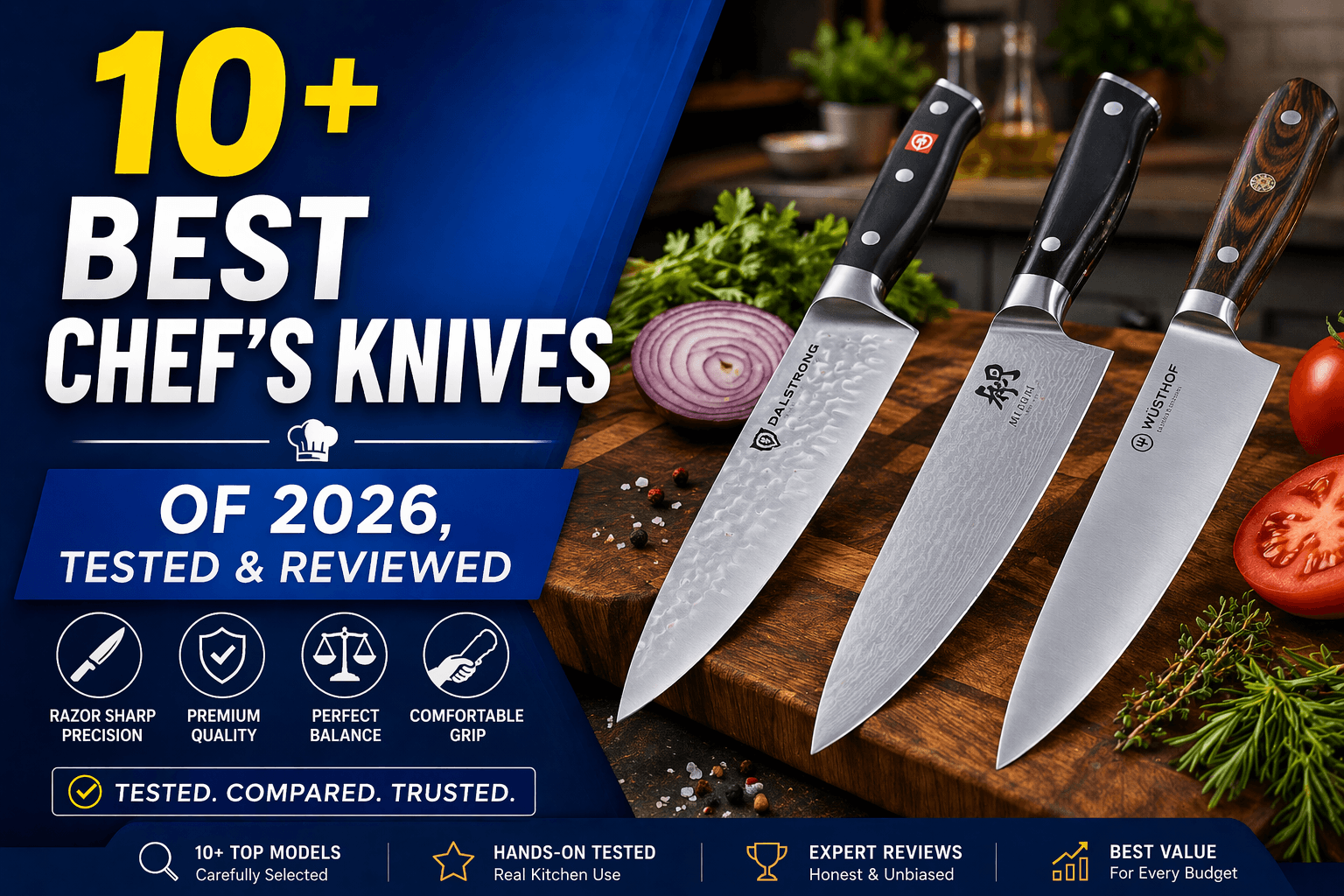
10+ Best Chef’s Knives of 2026, Tested & Reviewed
List Of 10+ Best Chef’s Knives of 2026, Tested & Reviewed, 1. BJ Knives, 2. Victorinox Fibrox Pro

You can view the products listed orsign up on Baramdat for free

A chef’s knife is one of the few tools in a kitchen that directly affects both speed and accuracy.
When a knife is well-balanced and properly sharpened, cutting becomes effortless. When it is not, even simple prep work starts to feel inefficient. That difference is what separates an average kitchen setup from a well-optimized one.
Today, buyers are no longer limited to what is available locally. Many now explore different knife categories, materials, and manufacturers through platforms like Baramdat, where products can be reviewed more systematically before making a decision.
That shift matters because chefs’ knives are not interchangeable tools.
They vary significantly in how they cut, how they feel, and how they perform over time. The knives in this guide are not selected for popularity alone. They are included because they consistently perform under real kitchen conditions.
How These Knives Were Evaluated
Testing a chef’s knife properly requires more than a quick impression.
A knife can feel sharp out of the box, but lose its edge quickly. Another may not feel exceptional at first but performs consistently with repeated use. That difference only becomes clear through practical testing.
Each knife here is considered based on how it performs across multiple tasks: slicing proteins, chopping vegetables of different densities, and handling repetitive prep work. Balance, fatigue over time, and ease of maintenance are equally important.
The goal is not to identify the most expensive knife.
It is to identify knives that maintain performance.
Understanding Performance Before Choosing a Knife
A common mistake when buying chef’s knives is focusing too much on specifications and not enough on behaviour.
Blade steel is important, but how it is treated matters just as much. A well-treated mid-range steel can outperform a poorly treated premium one. Geometry also plays a major role. A thinner blade cuts more efficiently, while a thicker blade provides more durability.
Then there is balance.
A knife that feels slightly front-heavy can make chopping easier, while a more neutral balance may reduce fatigue during longer prep sessions. These differences are subtle at first but become significant with regular use.
List Of Top 10+ Best Chef’s Knives of 2026
1. BJ Knives
BJ Knives is a manufacturer and exporter of handcrafted knives, specializing in Damascus steel blades built for durability, precision, and visual character. Known for custom work and global shipping, the brand focuses on combining traditional forging techniques with modern usability to deliver knives that perform reliably in both professional and everyday settings.
2. Victorinox Fibrox Pro
The Victorinox Fibrox Pro challenges the assumption that performance must come at a high price.
In real kitchen environments, it performs far above what its cost suggests. The blade geometry allows clean, efficient cuts, and the handle provides a level of grip that becomes especially useful during longer prep sessions or when working with moisture.
It is not a knife that focuses on refinement or visual appeal. Instead, it prioritizes usability. That focus makes it one of the most practical choices for both beginners and professionals who value function over presentation.
3. Shun Classic 8” Chef’s Knife
The Shun Classic introduces a different cutting experience.
Its thinner blade and sharper edge make it particularly effective for precise slicing. When working with vegetables or delicate proteins, the difference is immediately noticeable. The knife moves through ingredients with less resistance, which reduces effort.
However, this precision comes with responsibility. It is not designed for heavy-duty tasks. Misuse can lead to chipping or damage. For users who understand its strengths, it performs exceptionally well.
4. Global G-2 Chef’s Knife
The Global G-2 stands out primarily because of how different it feels.
Its lightweight construction and seamless design create a sense of control that heavier knives do not offer. This makes it particularly comfortable during extended use, where fatigue becomes a factor.
The blade itself is thin and efficient, but the real advantage lies in handling. It is a knife that encourages precision rather than force, which can improve technique over time.
5. MAC Professional Hollow Edge
The MAC Professional knife sits between Western durability and Japanese precision.
This hybrid approach is what makes it versatile. It can handle a wide range of tasks without feeling out of place. The hollow edge reduces sticking, which becomes noticeable when slicing vegetables.
Over time, this versatility becomes its defining feature. It is not the most specialized knife, but it adapts well to different situations, which is often more valuable in a working kitchen.
6. Dalstrong Gladiator Series
Dalstrong has positioned itself as a performance-focused brand, and the Gladiator series reflects that approach.
The knife is slightly heavier than some alternatives, which adds stability during chopping. While it may not have the refinement of higher-end brands, it delivers consistent performance across tasks.
It is particularly useful for users who want a dependable knife without entering the premium price range.
7. Miyabi Birchwood
The Miyabi Birchwood represents craftsmanship at a higher level.
Its blade is thinner, sharper, and designed for precision work. The attention to detail is visible not just in performance but also in construction and finish.
This is not a knife built for rough use. It is designed for users who appreciate control and are willing to maintain it properly. In the right hands, it performs exceptionally well.
8. Mercer Culinary Genesis
Mercer knives are often used in training environments, and there is a reason for that.
They provide consistent performance without unnecessary complexity. The Genesis series offers a balance between affordability and usability, making it suitable for everyday kitchen work.
It may not stand out in any single category, but it performs reliably across tasks, which is often what matters most.
9. Zwilling Pro Chef’s Knife
Zwilling’s Pro series emphasizes durability and balance.
The blade has a slightly thicker profile, which provides strength, while still maintaining reasonable cutting efficiency. It is a knife that feels stable and predictable, particularly during heavier tasks.
This makes it suitable for users who prefer a more traditional Western knife experience.
10. Tojiro DP Gyuto
The Tojiro DP Gyuto offers a more focused approach to cutting.
It is thinner, sharper, and more precise than most Western knives. This makes it ideal for slicing and detailed work, where control is critical.
However, it requires careful handling. It is not designed for tasks that involve excessive force. For users who prioritize sharpness and efficiency, it is a strong option.
11. Benchmade Kitchen Series
Benchmade’s entry into kitchen knives brings a different perspective.
Known for precision engineering in other blade categories, the company applies similar principles here. The result is a knife that feels controlled and consistent, with a focus on balance.
While still relatively new in the kitchen space, it reflects how knife design is evolving.
Performance Comparison Snapshot
This comparison highlights a key point.
There is no single “best” knife.
There is only the right knife for a specific use.
How to Choose the Right Knife for Your Kitchen
Choosing a chef’s knife becomes easier when the focus shifts from brand to use.
If most tasks involve chopping and heavier ingredients, a stronger Western knife may be more suitable. If precision work is more common, a thinner Japanese-style knife can make a noticeable difference.
Comfort should not be overlooked.
A knife that feels good in hand during short use must also remain comfortable during extended sessions. That is where balance and handle design become important.
Conclusion
The best chef’s knives of 2026 reflect a range of design philosophies rather than a single standard.
Some prioritize durability, others precision, and some aim to balance both. What connects them is consistency in real-world performance.
The difference between a good knife and a great one is not always visible at first.
It becomes clear over time, with use.
FAQs
1. What makes a chef’s knife perform well over time?
A chef’s knife performs well over time when it maintains its edge, resists wear, and remains comfortable to use. This depends on blade steel, heat treatment, and overall construction. A well-designed knife continues to cut efficiently even after repeated use and regular maintenance.
2. Are expensive chef’s knives always better?
Expensive knives often use better materials and have more precise construction, but they are not always necessary. Many mid-range knives perform extremely well in real kitchens. The best choice depends on how the knife will be used and how well it is maintained over time.
3. What is the difference between Western and Japanese chef’s knives?
Western knives are generally thicker and more durable, making them suitable for heavy tasks. Japanese knives are thinner and sharper, designed for precision cutting. Each style has advantages, and the better option depends on the type of cooking and personal preference.
4. How often should I sharpen a chef’s knife?
Sharpening depends on usage, but most knives benefit from sharpening every few months with regular honing in between. Frequent use may require more maintenance. Keeping the edge sharp improves performance and reduces the effort required during cutting tasks.
5. Can one chef’s knife handle all kitchen tasks?
A chef’s knife can handle most general tasks, including chopping, slicing, and dicing. However, specialised knives may perform better for specific tasks. While one knife can be sufficient, having additional tools can improve efficiency in certain situations.
6. What size chef’s knife is best for most users?
An 8-inch chef’s knife is generally considered the most versatile size. It offers a good balance between control and cutting capacity, making it suitable for a wide range of kitchen tasks. Larger or smaller sizes may be preferred based on individual comfort and use.
7. How do I maintain my chef’s knife properly?
Proper maintenance includes cleaning the knife after use, drying it immediately, and storing it safely. Regular honing helps maintain the edge, while occasional sharpening restores performance. Avoid using hard surfaces or dishwashers, as these can damage the blade and reduce its lifespan.
You might also like

Rock Phosphate Suppliers in Pakistan: A Buyer's Guide for 2026
By Muhammad Umar - 3 August 2026
Top 10 rock phosphate suppliers in Pakistan for 2026 - P2O5 grades, regions, MOQs, and what buyers should verify before ordering in bulk.

Fire Fighting Equipment Suppliers in Pakistan: A Buyer's Sourcing Guide
By Muhammad Umar - 3 August 2026
Sourcing fire fighting equipment from Pakistan? Compare extinguishers, hydrants, alarms & PPE, verify certifications, and connect with sellers on Baramdat.

Car Manufacturers in Pakistan: Complete 2026 Guide
By Muhammad Umar - 31 July 2026
See every PAMA-registered car manufacturer in Pakistan - Suzuki, Toyota, Honda, Hyundai, Kia, Changan, and more - with segments and verified sources.

7 Verified Disposable Syringe Manufacturers in Pakistan 2026
By Muhammad Umar - 31 July 2026
A buyer's list of Pakistan's disposable syringe manufacturers verified through DRAP registration and WHO PQS - names, cities, credentials, and what to check.