
By Muhammad Umar - 23 April 2026 · 9 min read
10 B2B Manufacturer/Distributor Classification Criteria
The top 10 B2B manufacturer/distributor classification criteria to streamline supplier discovery, sourcing decisions, and supply chain efficiency.
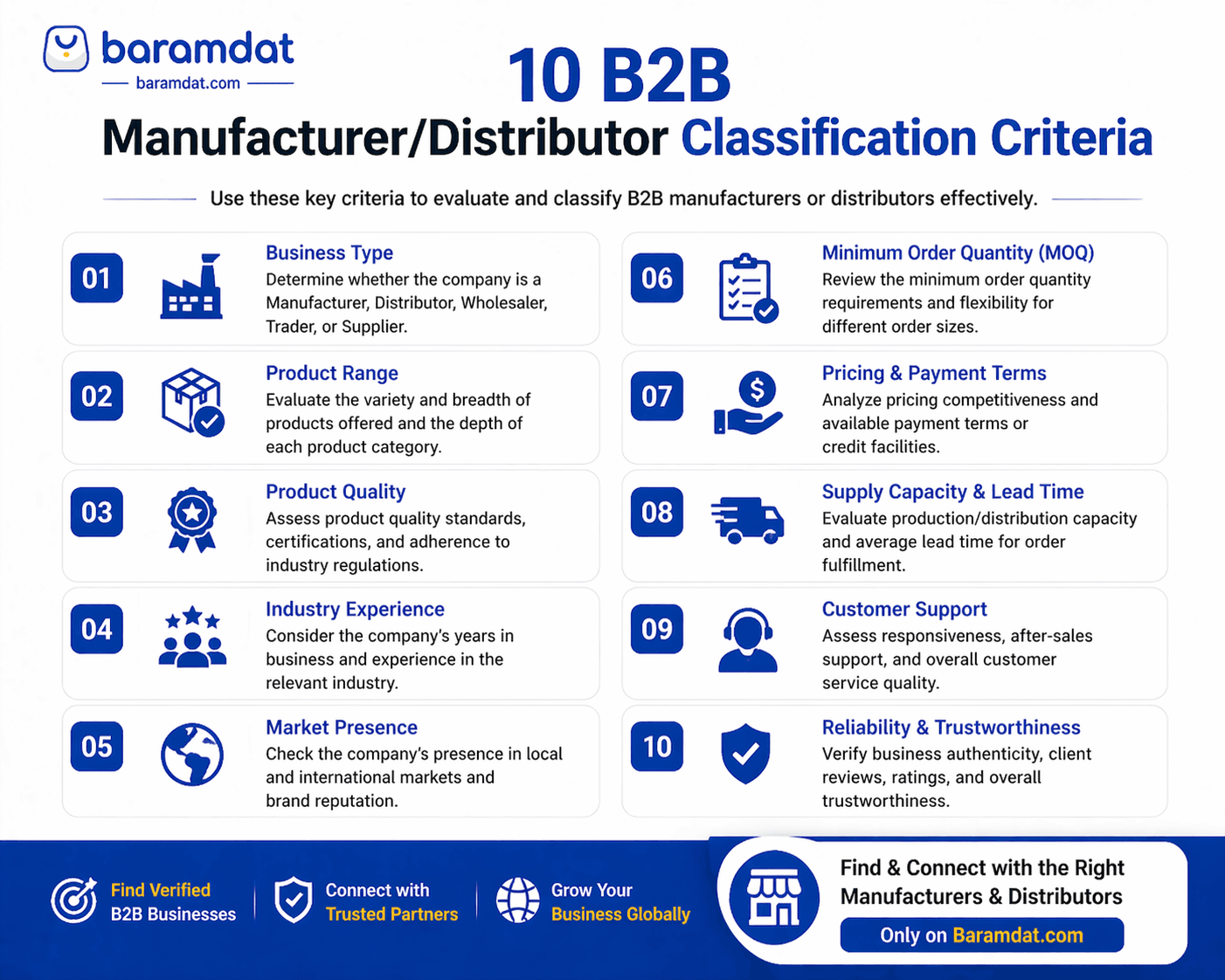
Sourcing from B2B manufacturers and distributors is not as straightforward as browsing a catalog. In fact, the vast diversity of the global market demands a more structured approach to supplier selection, especially when considering the wide range of criteria that define a strong business relationship.
When considering platforms like Baramdat, buyers are offered the opportunity to streamline the supplier discovery process. Instead of relying on generalized directories, these platforms provide clarity, allowing businesses to sort suppliers based on critical factors like production capacity, product specialization, and market expertise.
But finding the right supplier is not simply about choosing a business from a list. It's about understanding the underlying criteria that make certain manufacturers or distributors a better fit for your specific needs. Whether you are looking for a supplier for large-scale production or custom-made goods, understanding these top B2B manufacturer/distributor classification criteria is key to ensuring long-term success.
The Importance of Supplier Classification
Before diving into the specific criteria, it’s important to highlight why classification matters in B2B supplier sourcing.
In simple terms, classification helps businesses group suppliers into categories based on essential factors, helping companies identify those who align with their strategic objectives. This method reduces unnecessary trial and error and enhances procurement efficiency. Classification allows businesses to categorize suppliers into categories such as price, quality, geographical location, and product specialization.
The ultimate goal is simple: to minimize risk.
Whether sourcing components for manufacturing or finished goods for retail, ensuring that suppliers meet essential business standards is critical. Platforms like Baramdat offer buyers the ability to screen suppliers across these various criteria, helping businesses to make better-informed sourcing decisions.
Top 10 Manufacturer/Distributor Classification Criteria
1. Product Specialization
When classifying suppliers, product specialization is perhaps the most important criterion.
Manufacturers or distributors that specialize in specific product categories - such as textiles, chemicals, machinery, or consumer electronics - offer deeper knowledge, better craftsmanship, and a greater understanding of market demand. Specialized suppliers are more likely to have streamlined processes, ensuring that the quality of the goods they supply is consistently high.
For instance, when sourcing leather products, platforms like Baramdat allow buyers to filter suppliers based on the specific types of leather goods they produce, whether it’s leather apparel, accessories, or footwear. This makes it easier to connect with the right supplier and avoid suppliers who may offer only generic products.
By focusing on product specialization, businesses can ensure that their suppliers meet the technical and market requirements unique to their industry, ensuring a more customized and reliable outcome.
2. Production Capacity
Another defining classification criterion is production capacity.
A supplier’s ability to fulfill orders within a specific timeframe is often more important than price. Large-scale manufacturers, capable of high-volume production, are typically better suited to companies looking to source in bulk. On the other hand, smaller manufacturers might be a better choice for custom orders, specialized designs, or limited editions.
A good example of this would be sourcing raw materials for manufacturing large-scale products. A supplier with substantial production capacity ensures that deadlines are met consistently and quality is maintained throughout the production run.
By evaluating production capacity through platforms like Baramdat, buyers can avoid unnecessary delays and plan their procurement more efficiently.
For example, when sourcing leather goods, if a company specializes in mass-producing leather bags, but the buyer requires smaller, custom orders, it would be a mismatch. Hence, determining production capacity before contacting suppliers is critical.
3. Geographic Reach
In a globalized world, geographic reach plays a key role in classification.
Some manufacturers are geographically restricted, focusing primarily on local or regional markets, while others have the ability to export internationally, serving a wider client base. For businesses that are looking to source internationally, understanding the global presence of a supplier is essential.
Baramdat allows users to filter suppliers based on geographic location and supply chain capabilities, helping buyers identify those who can provide their services locally, regionally, or internationally. This geographic understanding is crucial for companies that operate across borders, ensuring that their supply chain remains intact, reliable, and consistent.
For example, sourcing leather goods for the U.S. market from Pakistani suppliers can be facilitated if the supplier has experience exporting to Western markets.
4. Quality Assurance & Certifications
When working with manufacturers or distributors, quality assurance is non-negotiable.
Quality certifications such as ISO 9001 or CE marking help buyers assess whether a supplier follows recognized industry standards. A strong quality assurance system guarantees that a product meets the required specifications and quality thresholds. Suppliers with relevant certifications reduce the risk of receiving subpar products and ensure long-term satisfaction with their goods.
For manufacturers in Pakistan, certifications such as ISO or Oeko-Tex® (for textile products) demonstrate that a supplier follows international standards and practices, reducing the buyer's risk.
Platforms like Baramdat give you easy access to such certifications, helping you connect with suppliers that are not just capable of meeting basic demands but can also deliver with high-quality control.
5. Financial Stability
A manufacturer or distributor’s financial stability speaks volumes about their ability to honor contracts, deliver on time, and sustain their operations over the long term.
A financially healthy supplier is more likely to meet deadlines and maintain the quality of their products. By assessing a supplier's financial background, companies can avoid potential supply chain disruptions caused by a supplier's financial troubles.
For B2B suppliers, a financially stable business often signals an ability to scale and adapt, which is crucial when dealing with long-term orders or large volumes.
For platforms like Baramdat, the option to review a supplier’s financial background or history, especially for those operating on an international scale, adds another layer of reliability to the supplier evaluation process.
6. Technological Expertise
In today’s competitive market, technological expertise has become a significant factor for manufacturers and distributors.
Manufacturers using advanced tools, AI-powered machines, or cutting-edge technology tend to deliver more precision and efficiency in production. They can adapt quickly to changing market demands, reduce waste, and offer innovative designs.
For example, a textile manufacturer utilizing high-tech machinery may have the ability to produce intricate patterns or improve the efficiency of textile production. Platforms like Baramdat allow buyers to assess whether a supplier uses advanced technologies, which can be particularly useful when looking for manufacturers in innovation-driven industries.
7. Supplier Lead Time & Flexibility
Lead time refers to the time taken between placing an order and receiving it.
The lead time is a crucial classification criterion, especially when dealing with perishable goods or time-sensitive markets. Some manufacturers can offer express delivery, while others may have longer production cycles due to the complexity of their work or raw materials.
Buyers should always evaluate lead time based on urgency and product type. With Baramdat, buyers can review a supplier’s average lead time, helping them plan their orders and avoid unnecessary delays.
8. Customer Service & Support
Customer service plays a vital role in a B2B relationship. The response time, communication clarity, and support quality a supplier offers can make or break a deal.
Whether it’s handling issues with delayed shipments or providing product specifications, top suppliers are proactive and transparent with their buyers. A supplier that offers solid post-sale support, easy communication channels, and detailed tracking systems is far more valuable than one that leaves you in the dark after an order is placed.
Baramdat enhances this by offering direct communication options for buyers and suppliers, ensuring that every transaction is accompanied by clarity and support.
9. Ethical Practices & Sustainability
With growing consumer awareness of sustainability, companies must pay attention to how their suppliers approach environmental impact and ethical practices.
Companies with certifications like Fair Trade or EcoCert demonstrate a commitment to ethical labor practices and sustainable production methods. This is especially crucial in sectors like fashion, textiles, and consumer goods, where buyers increasingly demand that suppliers meet eco-conscious standards.
Ethical practices are no longer optional. They can be a deciding factor in supplier classification.
10. Innovation & Design Capabilities
Innovation drives the competitive edge in B2B sourcing.
Manufacturers that consistently invest in research and development (R&D) are often more likely to offer products that meet market trends, improve performance, and push the boundaries of design. For businesses that rely on product differentiation, suppliers who specialize in innovative solutions offer considerable advantages.
Conclusion
The 10 B2B manufacturer/distributor classification criteria outlined here go beyond simple metrics.
While product cost and availability are important, the underlying factors like technological capability, financial stability, lead time, and ethical standards significantly influence the final decision. A platform like Baramdat takes this complexity and makes it more accessible by offering a structured way to evaluate, filter, and connect with suppliers.
By keeping these classification criteria in mind, businesses can build more reliable supply chains, optimize sourcing, and create more consistent products and services.
FAQs
1. Why is B2B manufacturer/distributor classification important?
Classification helps businesses filter suppliers based on key criteria such as product specialization, quality, production capacity, and geographical reach. This improves decision-making, reduces risks, and helps build stronger, more reliable supplier relationships, which are crucial for long-term success in B2B transactions.
2. How does production capacity affect supplier choice?
A supplier’s production capacity determines whether they can meet your volume requirements. Manufacturers with larger capacities are suited for bulk orders, while smaller suppliers might be more flexible for custom, low-volume orders. Knowing this helps businesses avoid delays or overcommitment risks in their supply chain.
3. How can technology improve B2B sourcing?
Suppliers with advanced technology can produce higher-quality goods more efficiently. They can also adapt more easily to custom orders and innovative designs. For buyers, working with technologically advanced suppliers means better consistency, faster delivery, and the ability to meet market trends with precision.
4. How do I evaluate a supplier’s quality standards?
Evaluating a supplier’s quality standards involves checking their certifications (e.g., ISO 9001), reviewing product samples, and verifying past work. Platforms like Baramdat make it easier to assess supplier credentials and connect directly with those who maintain high-quality practices throughout production.
5. Why are lead times important in supplier selection?
Lead times are crucial because they impact delivery schedules and overall operational efficiency. Suppliers with shorter lead times ensure that businesses meet deadlines and maintain inventory levels. A supplier’s ability to adjust lead times based on demand flexibility can be a significant advantage.
6. How does sustainability affect supplier choice?
Sustainability practices are increasingly becoming a deciding factor for businesses. Suppliers with eco-certifications and transparent sustainability practices ensure that products are sourced responsibly, which is increasingly demanded by consumers and regulatory bodies.
7. What makes a manufacturer/distributor reliable?
Reliability in B2B transactions comes from consistent product quality, timely deliveries, transparent communication, and the ability to meet contractual commitments. Evaluating these factors across suppliers helps reduce sourcing risks and build stronger, long-term partnerships.

You can view the products listed orsign up on Baramdat for free

You might also like
How to Find a Clothing Manufacturer: Domestic vs Overseas Options for Small Brands
By Muhammad Umar - 20 October 2026
How small brands find and vet clothing manufacturers: domestic vs overseas, where to look, what to ask, red flags and how to run a first order.
Rock Phosphate Suppliers in Pakistan: A Buyer's Guide for 2026
By Muhammad Umar - 13 October 2026
Top 10 rock phosphate suppliers in Pakistan for 2026 - P2O5 grades, regions, MOQs, and what buyers should verify before ordering in bulk.
Fire Fighting Equipment Suppliers in Pakistan: A Buyer's Sourcing Guide
By Muhammad Umar - 13 October 2026
Sourcing fire fighting equipment from Pakistan? Compare extinguishers, hydrants, alarms & PPE, verify certifications, and connect with sellers on Baramdat.

Car Manufacturers in Pakistan: Complete 2026 Guide
By Muhammad Umar - 13 October 2026
See every PAMA-registered car manufacturer in Pakistan - Suzuki, Toyota, Honda, Hyundai, Kia, Changan, and more - with segments and verified sources.